How website presence relates to income and Gift Aid for Friends of Hospital charities
Using Charity Commission data for 212 Friends of Hospital and League of Friends charities reporting income in 2023/24, we explored how reported website presence relates to fundraising income and Gift Aid registration.
Why this matters
Friends of Hospital charities, also known as Leagues of Friends or Friends of the Hospital, fund equipment, support patients and families, and improve hospital environments. Most are volunteer-led and rooted in their local community.
Building and maintaining a website can feel daunting, especially when time, confidence, and budgets are limited. It’s completely understandable that many groups have prioritised what they do best: supporting their hospital and community.
However, donor habits are changing. Supporters increasingly expect to find information online and donate quickly, often from a smartphone. We wanted to understand whether reporting a website is associated with two key outcomes: fundraising income and Gift Aid registration.
Where this data comes from
This insight uses publicly available information from the Charity Commission for England and Wales.
We looked at Friends of Hospital and League of Friends charities that:
- Are currently registered (not removed)
- Reported income greater than £0
- Filed accounts ending in 2023/24
That resulted in a sample of 212 charities.
Website presence is based on whether a charity reported a website in its Charity Commission return. If no website was listed, the charity is counted as not reporting one.
The aim is to identify patterns, not to prove that having a website directly causes higher income.
Friends of Hospital charities at a glance (2023/24)
- 107 reported a website; 105 did not
- Total income across all charities: £25.1m
- Charities reporting a website accounted for ~70% of total income
- Gift Aid registration was more than twice as common among charities reporting a website
Finding 1: Just over half report having a website
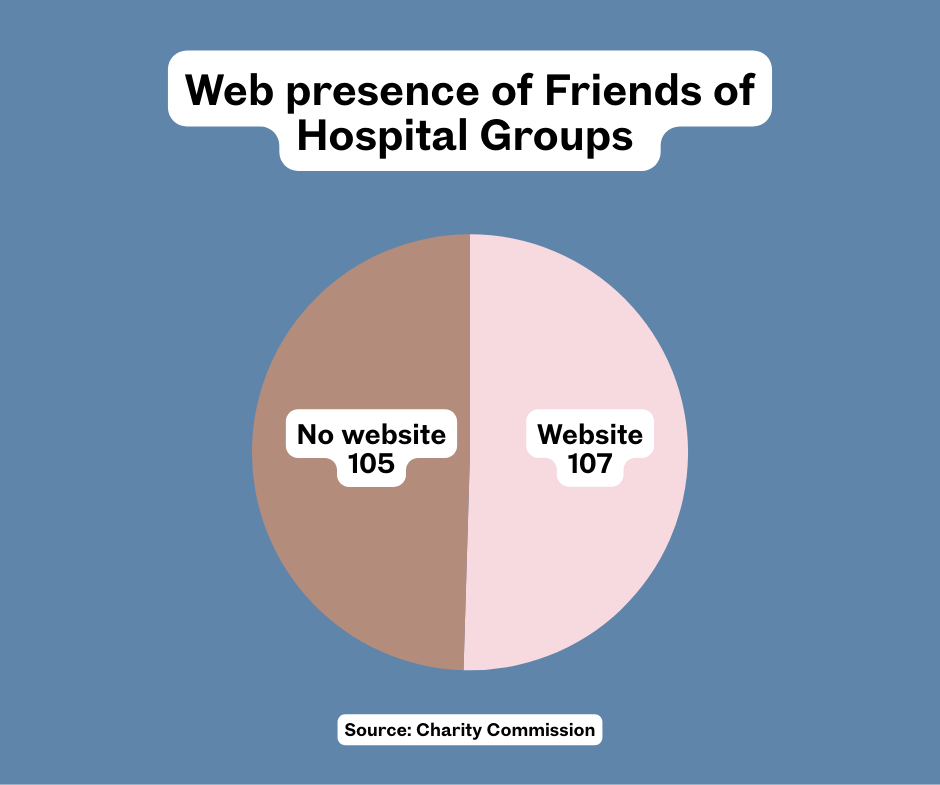
In this sample, just over half (107) reported a website in their Charity Commission return. The remaining 105 did not list one.
For volunteer led groups, not having a permanent online home can make it harder for supporters to quickly verify the charity, understand what it funds, and find a clear way to donate when motivation is high.
Social channels can be helpful for updates, but they aren’t designed as a stable fundraising base. Key information can be hard to find, links get buried, and supporters may not know where to donate or how to complete Gift Aid.
Finding 2: Website presence is associated with higher income
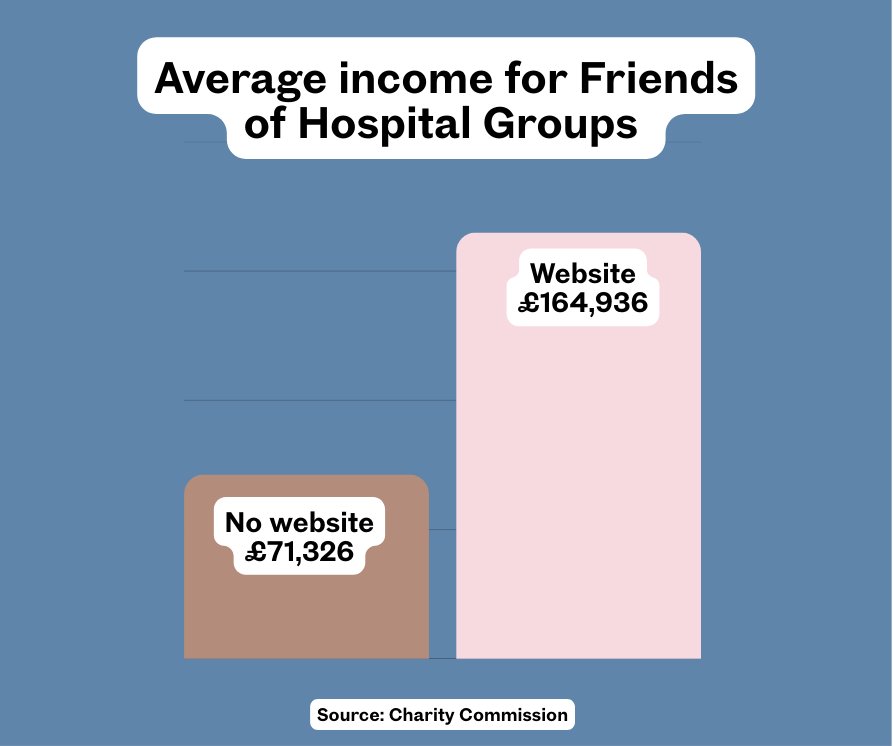
Charities reporting a website raised £17.6m in 2023/24, compared with £7.5m for those not reporting one.
Average income was £164,936 with a website versus £71,326 without.
This shows correlation, not causation: larger charities may be more likely to invest in a website. However, the scale of the difference suggests there may be untapped opportunity for some groups, especially where a clearer online presence makes it easier for supporters to find you and give.
Finding 3: Website presence is associated with Gift Aid registration
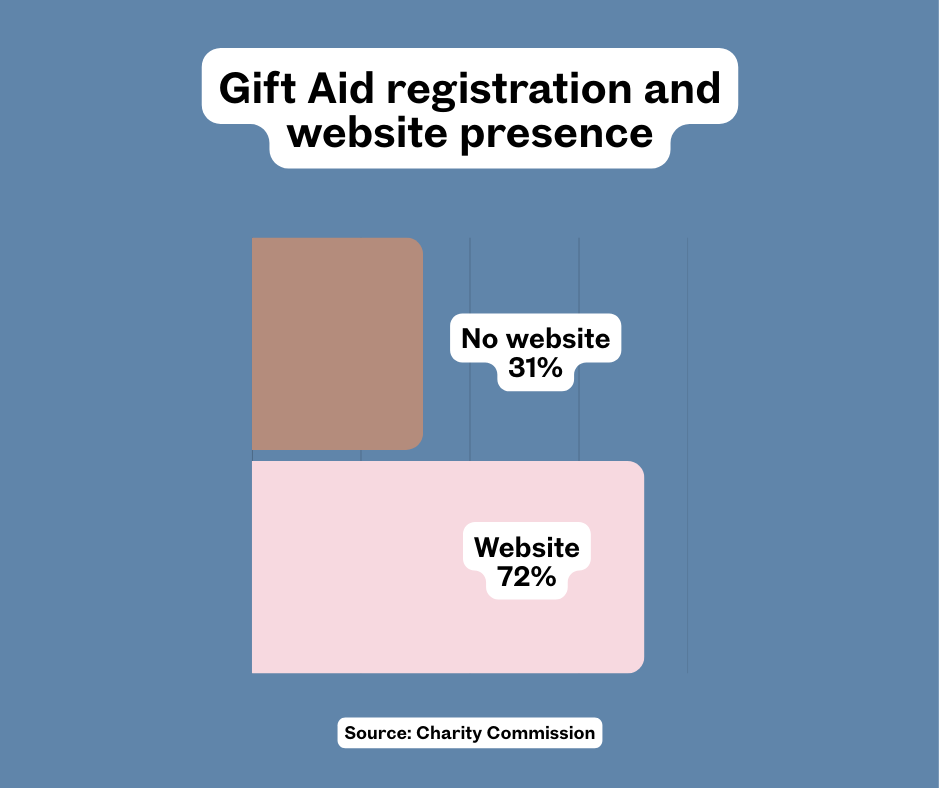
Gift Aid registration was substantially higher among charities reporting a website: 72% vs 31% among those not reporting one.
Gift Aid can increase eligible donations by 25%. A website makes it easier to explain Gift Aid, reassure donors, and include declarations as part of the donation journey.
What this means for volunteer-led groups
Many Friends groups rely on in-person events and long-standing local supporters. These remain important — and they’re often where Friends groups shine.
But donor behaviour has shifted. Supporters are less likely to carry cash and more likely to look for a quick online option when prompted by a noticeboard, a ward conversation, an event, or a social post.
When someone searches for a Friends group, a website can be the difference between a supporter finding a clear way to donate or giving up. That matters even more when Gift Aid is part of maximising donations.
Related insight: How smartphones and cashless payments are accelerating online donations.
From correlation to opportunity
This analysis shows correlation, not causation, but it highlights a practical opportunity. Even a basic donation-focused website can:
- Capture donations outside fundraising events
- Enable repeat giving
- Increase Gift Aid claims
- Reduce reliance on cash and cheques
For volunteer-led charities, small improvements in accessibility and trust can have an outsized impact.
Next steps
If your Hospital League of Friends group is looking to diversify fundraising income and make support easier to manage, Fundraisy brings donations and other giving options together in one simple, volunteer-friendly website. We would be delighted to discuss how we might be able to help.
Create your free Fundraisy websiteSources & limitations
- Data source: Charity Commission for England and Wales (Register of Charities).
Website presence is based on a self-reported field. Some charities may have an online presence not captured in the return. These results should be read as patterns, not proof that a website causes higher income.